What is a Petition?

Notes on the Histories of Recordkeeping

Category: Filing

  • Cromwell’s Records – Filing Annotations

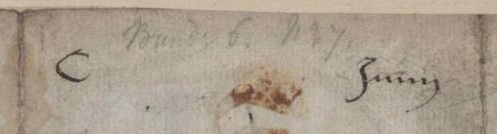
    C June
    “C Junii”
    National Archives SP 60/2 f.48 (dorse detail)

    1534 seems to be a transitional period for the manner in which Thomas Cromwell’s incoming correspondence was managed. Investigating starts at the back of these letters, the thicket of signs acquired over 500 years: folio numbering, dating, annotations of subjects, names and matters. At the bottom layer of this thicket is the letter-writer’s superscription, and then annotations of receipt, on what becomes a scribal work surface. A few unique filing annotations appear for a short period of time which seem to be linked to the record-keeping practice which I began to investigate in the previous post on cover sheets.
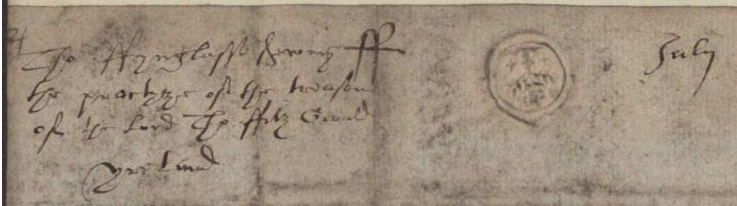
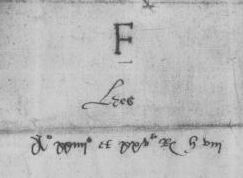
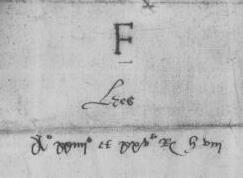
    F July
    “F July”
    National Archives SP 60/2 f.50 (dorse detail)

    Evidence for this practice barely makes an appearance at all in the State Papers, but the following focus on these types of annotation will show an indexical method at work. Most annotations on correspondence such as the fairly habitual recording of the name of the author do not have such a specific function. Along with the cover sheets of the previous post, these are contemporaneous and process-specific. I will start with some observations and introduce a hypothesis to account for their use. (1)

    There are 3 types of evidence for some kind of systematic organization that appear on the dorse of correspondence in the 1533-1534 period: the cover sheets for the span of one or two regnal years already described,
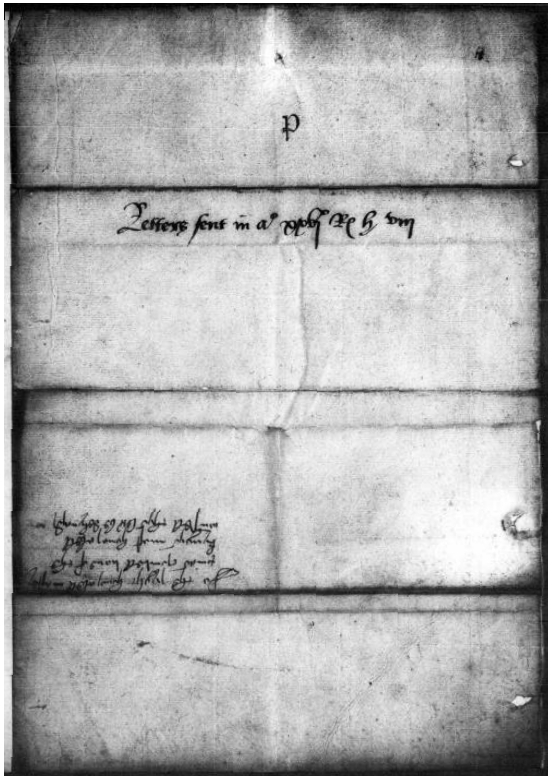
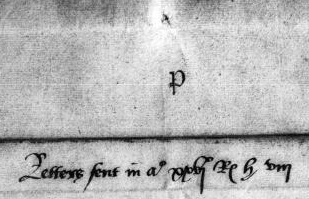
    P
    “P”
    “Letters sent in anno xxvi R H VIII”
    National Archives SP 1/79 f.78 (dorse)

    a further 9 or 10 items on which only a letter of the alphabet is informally drawn,
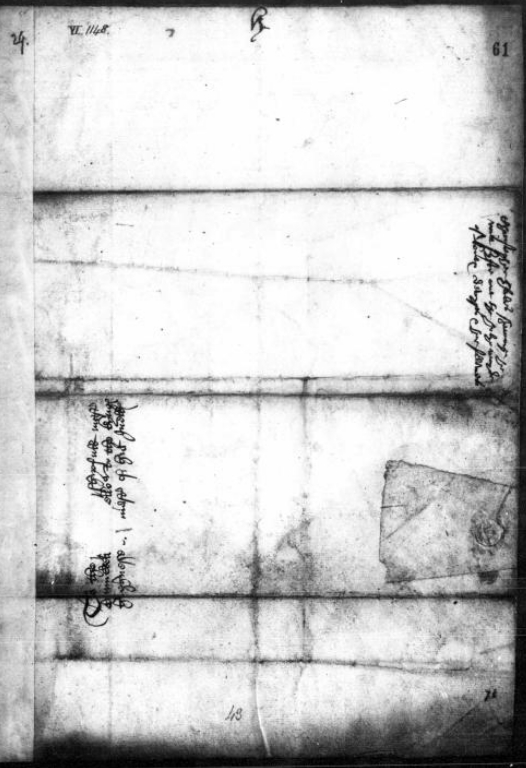
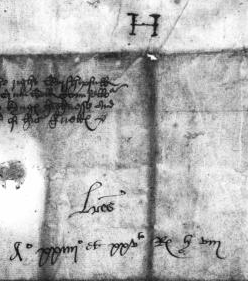
    H
    “H”
    National Archives SP 1/79 f.61 (dorse)

    and approximately 20 on which there are a combination of letter and month along one edge.
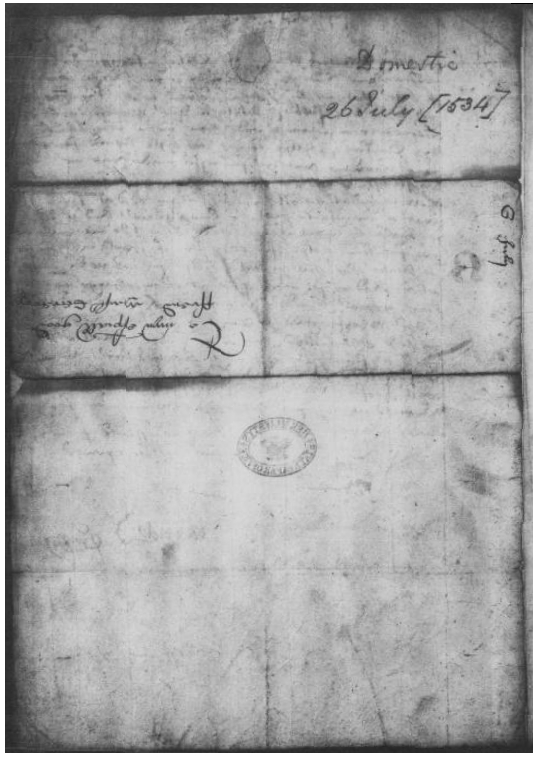
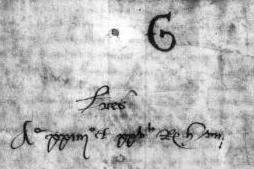
    G July
    “G July”
    National Archives SP 1/85 f.72 (dorse)

    The alphabetical characters on all 3 types index the name of the author of the correspondence on which they are placed. The letter and month combination index the author and month written.

    First, considering this combination of letter and month, it is a remnant of an unknown but particular goal-directed activity. When combined with a year, the two abstracted elements provide a filing location, and an intellectual order, although the relationship is not given: months arranged by name or names arranged by month? Being such a rare and short-lived form of annotation we can assume it was not a regular office practice, but peculiar to one individual, who followed a habit, or invented it for the occasion.
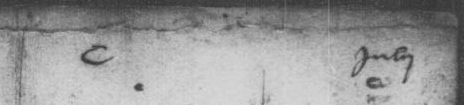
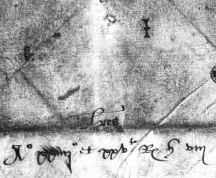
    C July SP 1/85 f.45
    “C July”
    National Archives SP 1/85 f.45 (detail from dorse)

    The clerical occasion may have been sorting for future filing, returning an item to a place retrieved from, or some other interaction with the organization of correspondence. Whatever its necessity, it points to a certain structure, and what must have been a large volume of records, otherwise its use would not have been needed.

    When considering that the 3 types could form inter-related elements of one system, their functions may become clearer. The following table illustrates the range by alphabet and the known or assumed dates given in the calendar entries for each piece of correspondence:
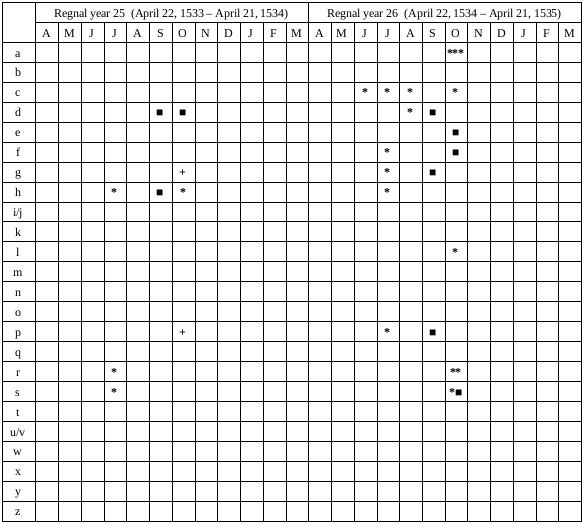
    filingTable
    Dates of correspondence and their annotations

    * = Month and letter annotations
    ■ = Single letter annotations
    + = 26th RY cover sheets (one is not dated so omitted here)

    One can immediately observe that there are two groupings over time, from June/July to October, in both regnal years 25 and 26. A kind of mirroring can be observed in the continuity of surviving letter groups over the two years. It seems odd however that someone would be performing the same task in the same way for only these months over two years. The calendared dates may be wrong in some instances, but there are enough dates which are obviously correct to make this possibility irrelevant.

    I think to make sense of this chronological range over two years we have to make an assumption: that in 1534 these items of 1533 correspondence (of any of the 3 types) were misfiled, and brought into the 26th regnal year aggregation. I will come to the reasoning for this shortly. If we accept this then all these annotations should be considered as made in 1534.

    If the single regal year aggregation (year 26) is a development of the previous two-year aggregation then the next logical division would be monthly, in response to an increasing amount of correspondence to manage. This is what the letter/month annotations point to. For regnal year 26 I think incoming correspondence was on receipt collected in groups by the initial letter of the author’s name, and within those groups chronologically, but face down. This regular chronological accumulation may be a difference from the previous two regnal year aggregates. It is how most modern office files grow, forming themselves in reverse chronological order, with the most recent documents on top.

    D August
    “D August”
    National Archives SP 1/85 f.106 (detail from dorse)

    The 26th regnal year did not end in October, so why do the annotations end there? I can think of two possible reasons. September 29 is Michaelmas, a division frequently used at the time for accounting periods; in fact inventories of Cromwell’s papers made by his servants frequently make use of this as a division. Perhaps more significantly, in early October Cromwell obtained the office of Master of the Rolls, which did not replace his position as principal secretary, but augmented his power. It increased his staff and shifted his base of operations to include a new physical location on Chancery Lane. October 1534 then would have been a time of putting things in order by his staff in his previous ‘home office’.

    It is this activity that can account for the creation of the letter and month annotations. They are pieces of correspondence which were found in out of the way places, or otherwise presented for filing within the already accumulated April to October stacks or files. Around the same time, in anticipation of closing these files, the top dorse was given a temporary letter label. This accounts for the pattern we see in the table above for the single-letter annotations on correspondence: they are written in September or October.

    The last step in the process of creating these files was the more formal regnal year labeling, on the topmost dorse of the by-now bound file, of which there are 3 examples extant. Again we can look to their dating to confirm this. One was written on October 6, one was written in October 14th, and the third is unknown. This last step seems to confirm their chronological order, at least to the extant of collecting by month. The cover sheets of the previous years do not have this pattern.

    So what we have, represented by these inconspicuous labels, is a sequence of interrelated activities: filing, labeling files, and then closing files with the addition of further identification of the series.

    Following are the annotations and UK National Archives document references:

    SP 1/86 f.34

    A

    October

    SP 1/86 f.110

    A

    October

    SP 1/86 f.127

    A

    October

    SP 60/2 f.48

    C

    June

    SP 1/85 f.45

    C

    July

    SP 1/85 f.103

    C

    August

    SP 1/86 f.50

    C

    October

    SP 1/85 f.106

    D

    August

    SP 1/85 f.144

    D

    SP 1/79 f.146

    D

    SP 1/79 f.96

    D

    SP 1/86 f.18

    E?

    SP 60/2 f.50

    F

    July

    SP 1/86 f.14

    F

    SP 1/85 f.72

    G

    July

    SP 1/85 f.178

    G?

    SP 1/238 f.125

    G?

    SP 1/238 f.92

    H

    July

    SP 1/85 f.47

    H

    July

    SP 1/79 f.166

    H

    October

    SP 1/79 f.61

    H

    SP 1/86 f.128

    L

    October

    SP 1/85 f.62

    P

    July

    SP 1/85 f.170

    P

    SP 1/77 f.185

    R

    July

    SP 1/86 f.32

    R

    October

    SP 1/86 f.106

    R

    October

    SP 1/78 f.55

    S

    July

    SP 1/86 f.23

    S

    October

    SP 1/86 f.12

    S

    (1) This evidence is restricted to what I have observed on the surrogate images, not the original records in the National Archives. I take these marks to be contemporaneous with their absorption into Cromwell’s record-keeping systems because their handwriting seems consistent, as well as the fact a few of the months recorded are not included in the text of the correspondence, so must of been known by the scribe (i.e. SP 1/86 f.128). The logic of the reconstruction also speaks to their creation while the office was active.
  • Cromwell’s Records – Incoming Correspondence to 1535

    SP_1/74 f.43 (dorse)
    State Papers 1/74 f.43 (dorse)

    If one had an interest in the government record-keeping practices of Tudor England the documentary source one would naturally turn to is the collection of State Papers housed in the National Archives.* The nature of their present organization however, an artificial collection of chronological order from a variety of records creators, frustrates any understanding. The disappearance of any original order has produced the present contorted physicality of these records. Nevertheless, one would expect to see some evidence of control over information and evidence.

    I think it is worthwhile to have a close look at what is available and see what we can see. Perhaps there are techniques of documentary organization and information management which are not obvious, but are there in some fragmented form. I’ll focus on the records of a person whose fame for administrative skills would seem to offer us the best potential, Thomas Cromwell (d.1540). The survival of copious incoming correspondence, as well as large inventories of a variety of document types, attest to the fact he retained a large amount of active and inactive records, for ongoing administration or future reference or otherwise. The breadth and scale of document-supported operations Cromwell conducted suggest a need for managing their effective use. However, the office’s methods of organizing these documents remains under-described.**

    The management of incoming correspondence in early modern England followed a basic pattern. After a piece of correspondence was opened and read by a secretary or one of his staff it could be re-folded into a docket shape and often endorsed, usually with the sender’s name, perhaps a brief summary of the matter, and perhaps a date. This process we can observe on most of the discrete items kept by Cromwell now remaining.

    There is also physical evidence of other forms of control. An examination of the dorse sides of the Cromwellian correspondence certainly shows evidence of folded docket management, but also, I would propose, another stage of unfolded accumulations. These accumulations, we can call them files, collected together incoming correspondence for particular time periods and in an alphabetical arrangement, and which were bound at the head. I don’t know when this aggregate was created, but it seems likely to me to be while in semi-active use, sometime before Cromwell was executed in 1540.

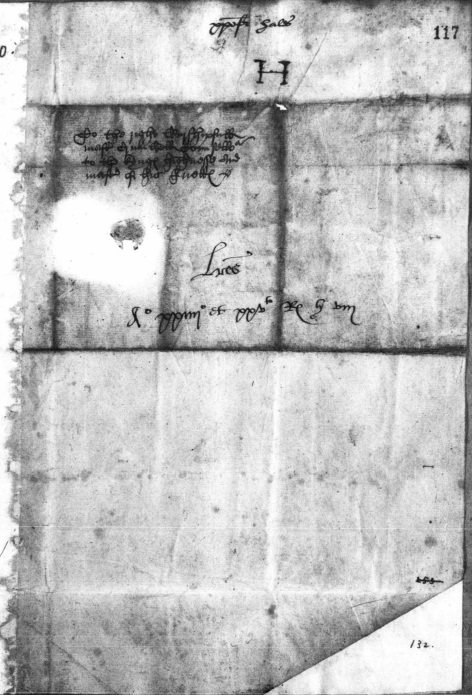
    Their arrangement was alphabetical. For instance, a letter dated October 17, 1532 includes an inscriptional-styled roman character ‘H’ on the dorse along with a description (Lres ao xxiiijo et xxvo R H viii) indicating that this was used as a cover sheet for  letters from the 24th and 25th years of the reign of Henry VIII, that is from April 22nd 1532 to April 21st 1534:

    SP 1 17 f.117 H
    State Papers 1/17 f.117 (dorse)

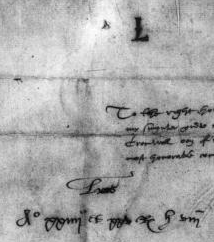
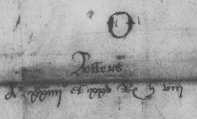
    This piece of correspondence to Cromwell, initially endorsed with the name of the sender Christopher Hales, has become a cover sheet for an accumulation of semi-active administrative records. There are also extant cover sheets for the letters F, G, I/J, L and O in the same format and covering the same time period.

    That this was part of a physical file can be seen from the puncture at the top of each cover. In the example above, directly under the abbreviated “Christopher”, is a hole in the paper where it would have been tied together with other “H” correspondence. For any other extant correspondence then, this puncture mark left by the file’s stitch is an indication it could have been included in one of these files. My rough survey of letters to Cromwell at this time indicate about 20-35% were included in this type of filing.

    Each cover represents the surname, or corporate name, of a writer on which it is labeled. The labels are written on letters from Sir William Fitzwilliam (Treasurer of the Household), Sir Edward Guldeford (Lord Warden of the Cinque ports), Christopher Hales (Attorney General), Richard Jones (?), Dr. John London (Warden of New College Oxford), and the Town of Oxford. Presumably many other writers would also have been captured in these alphabetical accumulations. The surviving names suggest that these files could have been a core series of incoming correspondence for Cromwell’s office staff; generally they are central figures in the day-to-day administration of the realm.

    Although Cromwell is the records creator he is not necessarily the addressee. Fitzwilliam’s correspondence is actually addressed to the Bishop of London, John Stokesley. It was included in Cromwell’s filing system because it was not a private letter; it represented government business. It consists of the king’s instructions to his servants, received from one councilor and forwarded to another. So Cromwell must have acquired it, and kept it, as a councilor carrying out its prescribed or related task. This is before the development of modern bureaucracy, but these written records are just as able to represent a structure of delegated authority and accountability.

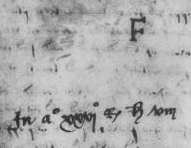
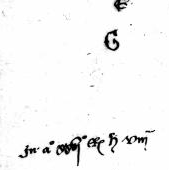
    In the 26th regnal year the two-regnal-year date range of the files is modified. Now, for a single regnal year, the 26th, there are at least three extant cover sheets with similar labeling, for the letters F, G, and P. Possibly this change reflects an increase in the volume of correspondence: the sorted units are adjusted down in scale for ease of use. Or it is just a new preference.

    A curious fact about these three of year 26, which will need to be explained before we really understand this level of organization, is that two of the three writers are the same as two of the six from the previous years: label ‘F’ is on correspondence from Fitzwilliam, and label ‘G’ on Guldeford’s, the same writers of the previous system’s ‘F’ and ‘G’ covers. It seems unlikely to be a coincidence, given the small number of examples. Perhaps it points to a non-chronological and non-alphabetical division within the file by some other category.

    There is at least one other cover sheet extant: “Italeon lettres and other matiers / In a° xxvj RH VIII” (SP 1/80 f.199v). I haven’t found others like this, perhaps because they were not regularly made; but it does point to a division of all correspondence into ongoing series. I am assuming the creation of these files was concurrent with the closing of the date range, and not a later organization. The possibility exists that all or some of this labeling is of a later hand, added by custodians after 1540, but I doubt it. In the absence of any evidence to the contrary, it would be more reasonable to assume the original record-keepers had a need for organizing correspondence by author and time period, for the sake of continual finding and managing, after their immediate use was past.

    There do not seem to be any cover sheets like these created in Cromwell’s office again. By 1535 this system of managing some of the correspondence primarily by regnal year was either modified somehow, or the cover sheets on the same model are now lost. Without any evidence I think we assume it was probably abandoned for another or similar system. This could be a sign the office was dealing with different kinds of business, or the focus had changed. In fact, in April 1534 Cromwell became Principal Secretary. It may be significant that in October 1534 Cromwell also acquired a new office, Master of the Rolls, and a new physical location for some of his clerical staff.

    Analyzing how Cromwell fit into Royal governance provides a key to the appearance and disappearance of this system. The two regnal year system begins from the time Cromwell was elevated from being a junior member of Henry VIII’s council to his first office, that of Master of the King’s Jewel House, in April of 1532. Then, once he became Principal Secretary to the king, in April 1534, his work and his relationship to the king’s council changed a great deal. Some other storage arrangement must have been created by the time the one regnal year file ends. Something with more ephemeral labeling, and perhaps including cabinetry. Something more expensive and modern may have been called for.


    F

    24TH and 25TH Regnal yearSP 1/74 f.43
    G
    24TH and 25TH Regnal yearSP 1/72 f.171
    H
    24TH and 25TH Regnal yearSP 1/71 f.118
    I/J
    24TH and 25TH Regnal yearSP 1/73 f.1
    L
    24TH and 25TH Regnal yearSP 1/72 f.97
    O
    24TH and 25TH Regnal yearSP 1/75 f.55
    F
    26TH Regnal yearSP 1/84 f.102
    G
    26TH Regnal yearSP 1/238 f.125
    P
    26TH Regnal yearSP 1/79 f.178


    *State Papers Online 1509-1714 is available through the portal Points to the Past.

    **Descriptions of the administrative context will help: Mary Robertson’s dissertation from 1975 “Thomas Cromwell’s Servants: The Ministerial Household in Early Tudor Government and Society”, while acknowledging the severe limits on any comprehensive analysis, provides a useful history of this writing office, its staff, and some of its practices. Michael Everett’s book “The Rise of Thomas Cromwell” describes Cromwell’s varied activities in the service of the crown, a noteworthy addition to the study of public administration for this time period.