The English Peasants’ Revolt of 1381 has a continuously re-envisioned history. An event with the appeal of an extraordinary and dramatic social revolution cannot hide from interpretation and narration. The story was once solely reliant on a handful of narratives written by contemporary or near-contemporary writers, but since the 19th century historians have relied also on official records created at the time of the rebellion, which seemed to promise a less biased and more objective view. The textual sources themselves change over time.
This is an account of one archival source, a petition to King Richard II, which has been absent from history, trapped in the clutches of its custodial practices, and in the assumption of its non-existence. The petition provides one small but authentic view of the aims and demands behind the revolt. Since the revolutionaries of the 14th century largely spoke through their actions very little documentary evidence otherwise remains.
In the mid-thirteenth century, the foolishness of a king of England, heavily in debt and obligated to the pope for a military adventure in Sicily, forced him to bargain away his domestic power in the hopes of financial relief. Thus, in 1258, a group of peeved magnates with the support of the nobility took over the government of Henry III. Without however challenging the idea of kingship, they then implemented administrative and judicial reforms which, temporarily at least, included the increased use of the querela, a legal proceeding initiated by informal oral complaint. The application of this method followed from the reformer’s desire to investigate the widespread abuse of royal power by local representatives of the crown.
Written complaints in petitionary form of this type are extant from much later in the century, 1292, from the reign of Henry’s more successful son Edward I. (In a previous post I discuss the nature of these “bills in eyre” and include a number of early examples.)
One court roll from the first year of this reform government includes what may be the first reference to a bill: a querela on a written document. The following detail shows the tail end of one of many membranes of a roll created by the English Justiciar Hugh Bigod. Of interest is the small slit at the foot the parchment and accompanying instruction: iunge id est billa “Join, that is the bill”.¹
Here, the bill itself, which may have been only the width of a finger, is long absent. It would have contained the details of a claim of trespass recorded on the same membrane, according to historian Andrew Hershey. As Hershey points out, this reference is unique. If complaints, usually oral, were written on bills these may have been kept with files of writs, now lost, and not usually attached to the roll, even temporarily as this one seemed to be.
The case which Hershey points out may be behind this querela is a dispute between the Abbot of Faversham in Kent and the Constable of Dover Castle. Hershey does not discuss the case or make any inferences about the dispute with regard to the bill. However, it would not be surprising that a Benedictine abbey had the wherewithal to present its case in writing. Ideally the plaint procedure was meant to open up the justice of a centralized authority to even the most humble and poor. The complaint from a powerful ecclesiastic landlord against a member of the reforming government’s newly appointed ruling council and constable of the most important castle in England, was not typical of those heard by Bigod.
In this instance the plaint involved a long standing argument over the manorial rights of the abbey and the community of Faversham. In an effort to escape as much as possible from the obligations and duties of the Abbey (their landlord) the residents had formally associated themselves with the Cinque Port of Dover. The confederation of Cinque Ports enjoyed a great deal of autonomy and power. Although economically and geographically distant from Dover, the townsfolk of Faversham’s agreement brought them under the protection of its charter. This brought them into deliberate conflict with the tenurial rights of the Abbey.²
A sidelong attack on the rights of the abbey was the basis of the written querela. The abbot complained that the new constable of Dover Castle, Richard de Grey, was responsible for holding an illegal court 25 miles away in Faversham, against the liberty of the abbot, and of breaking in to the abbot’s prison and taking prisoners there to his own jail. This sounds like a common kind of jurisdictional dispute over infangenethef, the right to capture and try any thief. For whatever reason Grey seemed to be involving himself in challenging the Abbey’s authority over the town of Faversham. The case was referred by Bigod to the Council, but the arguments continued for hundreds of years.
One of the first acts of this baronial council has been to appoint castellans. Richard de Grey may however have not been the best choice. He was removed from his post the next year for failing to recognize the subterfuge behind the letters allowing into England a papal ally of Henry who was threatening to excommunicate the barons.
An emissary from the pope had been sent to enforce an order in support of the bishop-elect of Winchester, who the reforming council had rightly exiled. The papal nuncio however could not enter the country without official permission, impossible to procure. The council had made sure the chancellor had sworn an oath not to act contrary to the wishes of the council and the ideals of the reform movement. It was the chancellor’s usual practice however to leave the great seal with a subordinate when he was absent from court. No one had thought to have this clerk swear the oath.
Henry, under the noses of the council, used the opportunity of the chancellor’s temporary absence to issue orders and a safe conduct to the constable of Dover Castle, Richard de Grey, who therefore escorted the safely arrived nuncio from Dover to a meeting in London of the king and stunned council. The council of course blamed Grey, he should have known better. But he had acted on what he considered reliable orders; the king however did not have the authority to issue those orders. Grey was duped by a perfectly ordinary order from the crown sealed with the Great Seal, the highest form of warrant. He was relieved of his post and the Justiciar Hugh Bigod replaced him as constable.
But for this kind of oversight, the Council at this time held the machinery of government in its hands, and was willing to correct the abuses of the nobility as well as of the crown. When the abbot’s case was referred to the council, they were still in the midst of transforming local government and creating legal reforms known as the Provisions of Westminster. An attempt was made to extend the investigations of administrative delinquency to all landowners and their representatives. It seemed like a new era of expertise was being born. But the broad use of querela was becoming an issue, and the reforming proposals of the government would eventually stall and mire in the “selfish conservatism of the mass of the baronage.” (Treharne, Baronial, 178)
In discussing the evidence for the existence of written querela, Hershey makes an important distinction between references to a cedula, and references to billa: “the former is a rather nondescript sheet, schedule or document which may have been attached to something else. While the latter, billa, is also a schedule, it carried with it preceptory implications.” (Hershey, Earliest, 231). The distinction will have continuing relevance. Petitionary form is common to many documents including preceptory actions, recognized by a legal system as initiating a procedure. It may be difficult to distinguish these two types of petition by their form alone, but a preceptory petition will likely have particular imposed rules or conventions.
When we see the culmination of Bigod’s judicial mission, reaching the City of London at the end of 1258, we can understand how important this distinction would have been to the clerks of 1259. Londoners, in the words of historian Treharne, “indulged in an orgy of querelae…. The Justiciar, as usual invited all men to show their grievances, and, allowing neither summons nor essoins [excuses] terminated the cases at once without observing the normal procedure. The majority of cases were querela:
“Personal transgressions such as assaults, cases of theft, debt, assignment of dower, disputes on the execution of the terms of a will, alleged disseisins [dispossessions] and other pleas of land….” However, “to the formalism of thirteenth-century land-law, the querela appeared a frivolous method of procedure when applied to the solemn matters of tenure and possession of land…. Whither this outrageous flouting of the grave, decorous and slow forms of established procedure might lead, none could tell. The landowning magnates at once took alarm, for it was in matters of freehold that this lack of orthodoxy seemed most horrible, and the magnates were therefore the chief enemies of the querela. Accordingly, in their charter of February, 1259,³ they insisted that all matters of freehold must be tried by writ and in the customary places. …the tendency to widen the use of the querela was always present, and the barons were very careful to restrict it in future to cases of personal transgression.” (Treharne, Baronial, 152-153)
The coalition of peers soon dissolved, the king regained his power, but then the movement’s ideologues pulled off a successful coup. So for a few years a second farcical stage of reform bloomed, and a dictator was chopped to pieces before royal normalcy set it with the Edwards.
Such a chaotic atmosphere was likely to engender creative bureaucratic methods, such as the temporary attachment of a written querela. At the same time the political structure limited the use of this form of petition. As the government of the crown expanded, carrying with it the selective obligation to dispense justice to all, local private jurisdictions and interests were threatened. Local agents of the crown would also continue to be subject to scrutiny, depending of course on the inclination of whomever ruled. The complainant’s bill would thereafter be more visible in the written record used as an investigative tool in governance and public order.
1. The existence of this reference was first pointed out by Andrew Hershey in his PhD thesis.
2. The history of relations between Faversham and the Abbey, including the Grey episode, are described by Murray.
3. The charter Treharne refers to, also known as the Ordinances of the Magnates, was a description of general aims of the reformers produced by the council as they drafted the details of reform legislation. In it they promise to abide by the same rules imposed on the crown, confirmed by royal letters patent. [Treharne, 137] The ordinationes facte per magnates de consilio regislink [Treharne, 158]
Bibliography
Hershey, Andrew H. An Introduction to and Edition of the Hugh Bigod Eyre Rolls, June 1258-February 1259: P.R.O. Just 1/1 187 & Just 1/873. (unpublished PhD thesis, 1991.) available at EThOS
Hershey, Andrew H., editor. Special Eyre Rolls of Hugh Bigod 1258-1260, vols. 1 & 2, (London : Selden Society, 2021)
Hershey, Andrew H. “The Earliest Bill in Eyre: 1259,” Historical Research, vol. 71 no. 175 (June 1998), pp. 228-232.
Murray, K.M.E. “Faversham and the Cinque Ports,” Transactions of the Royal Historical Society, vol. 18 (Dec. 1935) pp. 53-84.
Treharne, R.F. “An Unauthorized use of the Great Seal under the Provisional Government in 1259,” The English Historical Review, vol. 40 no. 159 (July 1925), pp. 403-411
Treharne, R.F. The Baronial Plan of Reform, 1258-1263. Manchester University Press, 1971.
Links
Justiciar’s (Hugh Bigod’s) roll of assizes, presentments, gaol delivery and essoins, The National Archives (UK). link to description and series description
In 1292 the English king’s justices at Shrewsbury in Shropshire heard the complaint of Thomas Colle of Shropshire against his brother who owed him money. He brought his legal action before the itinerant and omni-competent Justices of the General Eyre. Since the 12th century English kings had intermittently sent judges out on these visitations to the country, extending royal justice and power.
The usual procedure for a civil action such as Thomas Colle’s was to purchase a writ from Chancery. In this case the action was commenced by querela, a less costly and faster procedure based on an oral complaint. Over time the oral complaint was augmented by a written form, the bill. Bill procedure however played only a small part in the business of the eyre.
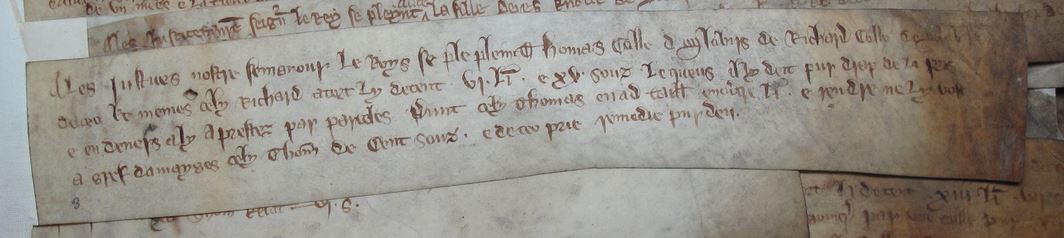
UK National Archives JUST 1/1552 m.3
Except for a few instances, the bill was written out for the complainant by an experienced writer: perhaps a clerk of the local bailiff or sheriff, or a clerk of the justices. The bill’s 3rd person wording usually followed a typical form: an address to the king’s justices, the details of a grievance, and a prayer for remedy:
A les Justices nostre Seignour Le Roys se ple [sic] pleint Thomas Colle de Slobirs de Richard Colle de Slobirs de ceo ke memes cely Richard atort ly detent vj.li. e xv. souz lequeus il ly deit pur drap de la pris e en deners a ly aprestez par parceles dunt cely Thomas en ad taill encuntre li e rendre ne ly vost a gref damayges cely Thomas de Cent souz e de ceo prie remedie pur deu.
[Thomas Colle of Shrewsbury complaineth to the Justices of our Lord the King of Richard Colle of Shrewsbury that that same Richard wrongfully detaineth from him £6 15s. which he oweth to him for cloth bought all at one time and for money lent to him in sundry sums, in acknowledgement whereof the said Thomas hath a tally; which sum the said Richard will not pay him, to the grievous damage of this Thomas of a hundred shillings. And of this he prayeth remedy for God’s sake. (transcribed and translated by Bolland)]
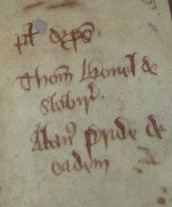
Another writer, a clerk of the court, would use the bill to make annotations as the case progressed. Here the back of the bill has the names of two pledges for prosecution, Thomas and Alan:
JUST 1/1552 m.3 dorse
The result was that brother Richard acknowledged to the judges his debt and promised to pay what he owed, in installments.
Thomas Colle’s bill begins the selections transcribed, translated into antiqued English, and published by William Bolland in 1914. See this link for a PDF of Select Bills in Eyre, A.D. 1292-1333. Those of 1292 and 1293 are probably the earliest extant.
This amazing preservation is due to luck and neglect as well as modern conservation. The bills were strung on thongs when finished with. These files were eventually submitted to the treasury along with files of writs and the justices’ rolls, but really of no use to anyone, and largely ignored by historians. Today the individual bills are preserved in volumes at the National Archives in the UK.
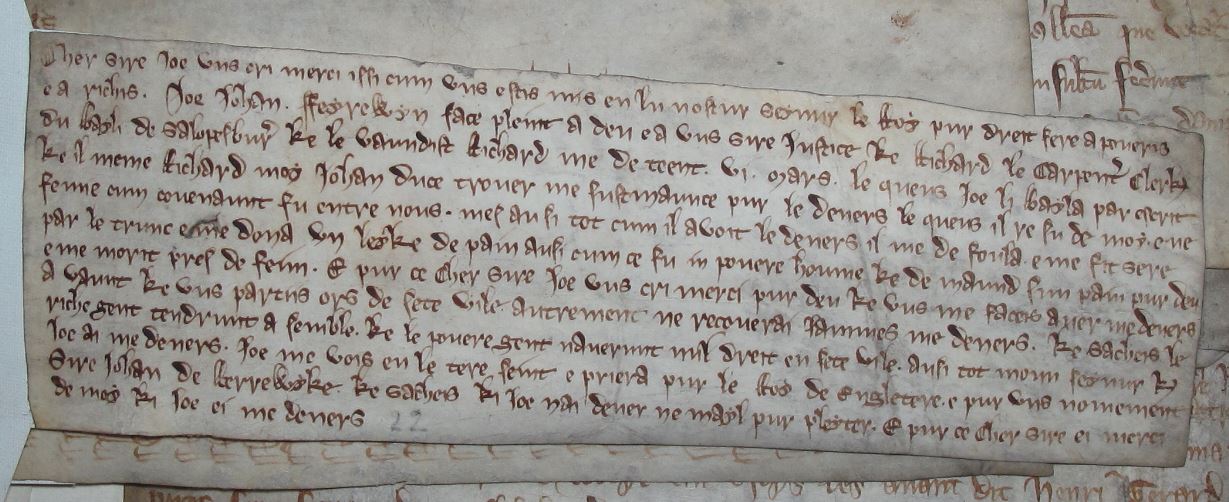
The stories related in the bills can be exciting, mystifying and commonplace. Not as typical as the familial complaint of Colle’s is the cry for mercy of bill 11, written by the complainant himself, appealing to the king’s desire to bring justice to rich and poor alike:
Cher sire joe vus cri merci issi com vus estis mis en lu nostur seinur le Roy pur dreit fere a poueris e a riches. Joe Johan Feyrewyn face pleint a deu e a vus Sire Justice ke Richard le Carpenter Clerk du bayli de Salopesburie ke le vaundist Richard me de teent .vj. mars le quenz joe li bayla par escrit ke il meme Richard moy Johan dute trouer me sustinaunce pur le deners le queus il resu de moy e ne fe mie cum couenaunt fu entre nous mes ausi tot com il auoit les deners il me desoula e me fit sere par le trunc e me dona vn leyke de pain ausi com ce fu vn pouere homme ke demaunde vn pain pur deu e me morit pres de feim. E pur ce Cher Sire joe vus cri merci pur deu ke vus me facers auer me deners auaunt ke vus partus ors de sete vile autrement ne recouerai jammes me deners ke sachers le riche gent tendrunt a semble ke le pouere gent nauerunt nul dreit en sete vile, ausi tot moun seynur ki joe ai me deners joe me vois en le tere seint e priera pur le Roy de Engletere e pur vus nomement Sire John de Berrewyke. Ke sachers ki joe nai dener ne mayl pur pleyter. E pur ce Cher Sire ei merci de mey ki joe ei me deners. [transcribed by Bolland from JUST 1/1552/11]
JUST 1/1552 m.11Cognoscit et concordati per licentiam [JUST 1 1552 m.11dorse]
These and other photographs of the filed bills from which Bolland selected can be viewed at the Anglo-American Legal Tradition website.
The following table lists the earliest bills published by Bolland, with links to the AALT images that I have been able to identify:
Bills in the Eyre of Shropshire of 20 Edward I [1292]
These bills are held by the UK National Archives series JUST 1, files 1552 /1553 /1554
Bills in the Eyre of Lincolnshire 14 Edward I [1285]
Bolland has probably misidentified these three bills. David Crook points out there was no Eyre in Lincolnshire at this time, and the bills are not Eyre bills.
Bibliography
Baker, J.H. An Introduction to English Legal History 4th ed. Oxford 2007.
Bolland, William, ed. Select Bills in Eyre, A.D. 1292-1333 Seldon Society no. 30 (1914) link
Crook, David. Records of the General Eyre. London : H.M.S.O., 1982.
Harding, Alan. “Plaints and Bills in the History of English Law, Mainly in the Period 1250-1330” in Legal History Studies 1972. Cardiff : University of Wales Press, 1975.
A reproduction of Chaucer’s 1385 petition is published in The British Inheritance: A Treasury of Historic Documents, from which the following images were made. The caption to the reproduction states in part: “It is probable that one of these hands is Chaucer’s, but it is impossible to say which.” (p.31) This is clearly mistaken.
Although there are no positively known samples of Chaucer’s handwriting with which to compare, the text of the petition was probably not written by Chaucer, but by a hired public scrivener, possibly by the name of Adam Pinkhurst.
Public Record Office, C 81/1394/87 (detail)
This identification is the conclusion of Chaucer scholar Simon Horobin based on his paleographic analysis of the petition, as well as other scholarship identifying Pinkhurst as a scribe who worked on the earliest extant copies of Chaucer’s poetry. Pinkhurst is known to have been a member of the scrivener’s company guild in London, and probably was employed to copy or write a variety of document types, some requiring the use of the functional and terse court-hand seen in Chaucer’s petition, as well as a more literary hand. Chaucer presumably went to the shop of this scrivener with a draft, to have it written out in a professional manner.
An additional piece of literary evidence put forward for the identification is a short poem by Chaucer from this time period “Wordes unto Adam, His Owne Scriveyn”:
Adam scriveyn, if ever it thee bifalle,
Boece or Troylus for to wryten newe,
Under thy long lokkes thou most have the scalle,
But after my makyng thow wryte more trewe;
So ofte adaye I mot thy werk renewe,
It to correcte and eke to rubbe and scrape,
And al is thorugh thy negligence and rape.
I wonder if Chaucer had also to correct his scribe, clearly accustomed to writing quickly, when he produced his petition.
Robert
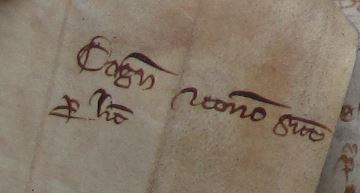
The writer of the notification of the king’s assent, above the text of the petition,
Public Record Office, C 81/1394/87 (detail)
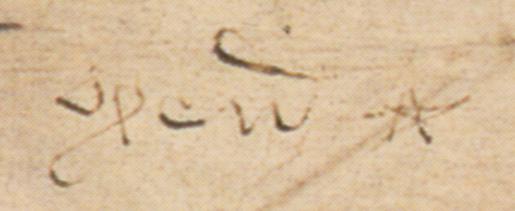
and the signature below,
Public Record Office, C 81/1394/87 (detail)
was Robert de Vere, ninth earl of Oxford. De Vere was Chamberlain of England, and the eighteen-year old king’s close political ally and recipient of largesse. In converting the petition to a warrant for the issue of letters patent under the great seal he was acting in a secretarial capacity for the king. He uses the name Oxen, short for Oxenford, and includes a scribbled graphic element. In Life-Records this is described merely as an asterisk, a description repeated by every other writer on the subject. Upon close examination however, and visible in other examples, one can see it is a five-pointed star, in heraldic terminology a “mulet”. The Earl of Ox[en]ford uses it here as an emblem representing his family name of De Vere, who held a hereditary claim to the office of Chamberlain of England.
The star is a prominent and famous element of the De Vere coat of arms. There are at least two stories in which this mulet plays a leading role. The first is the 11th century origins of the De Vere star, a legendary episode of the crusades, in which an army is saved by God’s intercession on behalf of the Christian crusaders, shining a saving light on the standard of Audrey de Vere on a night of fighting near Antioch. The second, more absurd episode occured during the Wars of the Roses. At the foggy Battle of Barnet in 1471 an army mistook the flags of its ally (a De Vere) for that of its enemy, fumed at the sight of white roses (or perhaps splendorous suns), attacked their ally, and the battle turned.
Bibliography
Crow, Martin Michael, Clair Colby Olson, and John Matthews Manly. Chaucer Life-Records. [Austin]: University of Texas Press, 1966.
Gillespie, Alexandra. “Reading Chaucer’s Words to Adam.” The Chaucer Review. 42.3 (2008): 269-283.
Horobin, Simon. “Adam Pinkhurst, Geoffrey Chaucer, and the Hengwrt Manuscript of the Canterbury Tales.” The Chaucer Review. 44.4 (2010): 351-367.
Hulbert, J R. “Chaucer and the Earl of Oxford.” Modern Philology. 10.3 (1913): 433-437.
Mooney, Linne R. “Chaucer’s Scribe.” Speculum. 81.1 (2006): 97-138.
Prescott, Andrew. “Administrative Records and the Scribal Achievement of Medieval England.” in Edwards, Anthony S. G, and Orietta Da Rold, eds. English Manuscript Studies, 1100-1700: Volume 17. London: The British Library, 2012.
Prescott, Andrew, and Elizabeth M. Hallam. The British Inheritance: A Treasury of Historic Documents. Berkeley: University of California Press. 1999.
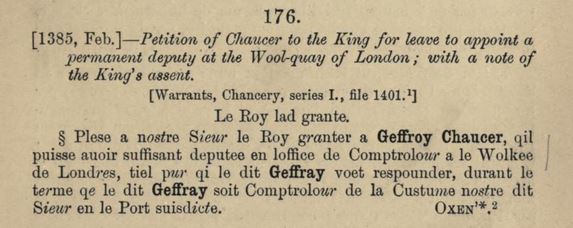
In 1385 Geoffrey Chaucer, who held the office of controller of wool customs at London, requested permission from the king to appoint a sufficient deputy for as long as he held the office. The following is the text of his petition to Richard II preserved in the UK National Archives [C81/1394/87], published in Life-Records of Chaucer:
Life-Records of Chaucer, Part IV ed. R.E.G Kirk, London : Published for the Chaucer Society by K. Paul, Trench, Trübner & Co., 1900 .p.251
The brief notes to the text provide some basic information about the petition: that it is written in an ordinary chancery clerk’s hand, probably not written by Chaucer himself, and signed by the ninth earl of Oxford.
At this time Chaucer had been a London customs controller for about 10 years, having been appointed by Edward III to this minor but politically sensitive office. The controller acted as a royal check on the accounts of the collector of customs. An early biography of Chaucer describes the episode in an inventive and dreamy fashion. This is from Chaucer’s Life by Walter Skeat:
In 1385, a stroke of good fortune befell him, which evidently gave him much relief and pleasure. It appears that Chaucer had asked the king to allow him to have a sufficient deputy in his office as Comptroller at the Wool Quay (in French, Wolkee) of London. And on Feb. 17, he was released from the somewhat severe pressure of his official duties (of which he complains feelingly in the House of Fame, 652-660) by being allowed to appoint a permanent deputy. He seems to have revelled in his newly-found leisure; and we may fairly infer from the Prologue to the Legend of Good Women, which seems to have been begun shortly afterwards, that he was chiefly indebted for this favour to the good queen Anne.
In the 1920’s a new project to publish the Life Records was begun, with the aim to provide a foundation of primary sources on which biographers and historians could rely. This was eventually published in 1966 as Chaucer Life-Records. This edition provides extremely rich descriptions of all the documents printed, including the 1385 petition. There is a valuable discussion also of the operations of the customs service, and the types of records it produced.
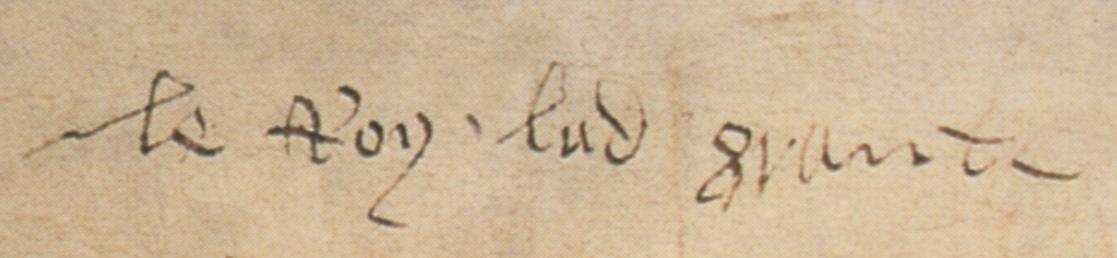
Here are some of the descriptive details this edition includes: “the signature (with an asterisk) and the phrase Le roy lad grante are in another ink and in the same, contemporary, hand, much less formal than that of the record itself….”, the “notification of assent [Le roy lad grante] and the name Oxen below is probably that of Robert de Vere, the ninth earl of Oxford …. by this addition the record became a sufficient warrant for the sealing of the letters patent ….” [p. 169] The background provided by the editors further explain that permission to appoint a deputy for a controller was rare. As a writer of a counter-roll representing the king’s interests at the audit of the collector’s accounts, the controller was expected to perform his duties in person and must have done so. Chaucer however had been given permission to appoint a temporary deputy on a few occasions prior to this, because he was directed to perform other duties on behalf of the king.
The actual letters patent issued to the controller has not survived. However, the enrolment of this license on the Patent Rolls is in the UK National Archives [C66, 8 Ric. II, Pt. 2, m. 31]. The text of the enrolment is published in Chaucer Life-Records (p. 168-9):
Pro Galfrido Chaucer.
Rex omnibus ad quos etc. salutem. Sciatis quod de gracia nostra speciali concessimus et licenciam dedimus dilecto nobis Galfrido Chaucer contrarotulatori custumarum et subsidiorum nostrorum in portu civitatis nostre Londonie quod ipse officium predictum per sufficientem deputatum suum pro quo respondere voluerit facere et excercere possit quamdiu idem Galfridus in officio steterit supradicto absque impedimento collectorum custumarum et subsidiorum nostrorum predictorum in portu predicto pro tempore existencium (seu aliorum quorumcumque). In cuius etc. Teste rege apud Westmonasterium xvii Februarii.
Per ipsum regum
There is no evidence Chaucer used this permission to appoint a deputy, and lost the position the next year.
But I am not here especially concerned with the biography of Chaucer. In following posts I will describe the brief life of his petition.
Bibliography
Crow, Martin M. and Clair C. Olson, eds. Chaucer Life-Records. Oxford: Clarendon Press, 1966.


 What is a Petition?